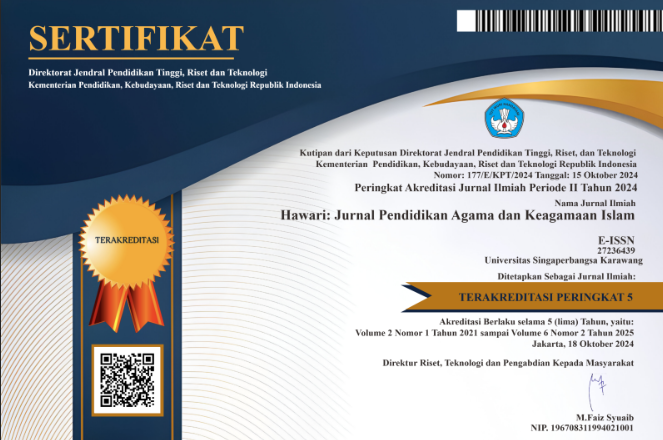
Ownership and Management Information

JOURNAL OWNERSHIP AND MANAGEMENT POLICY

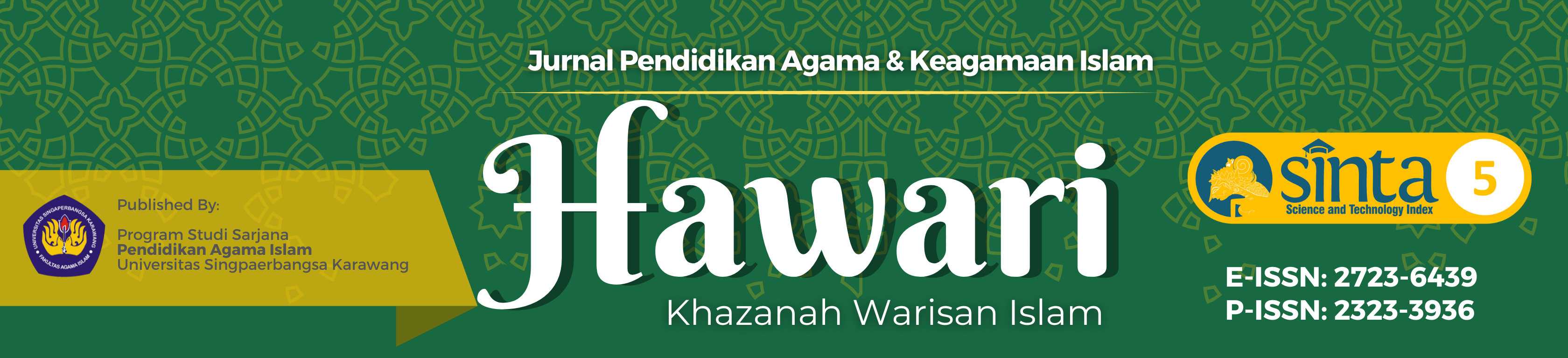
HAWARI: Jurnal Pendidikan Agama dan Keagamaan Islam is an academic journal affiliated with the Faculty of Islamic Studies, Universitas Singaperbangsa Karawang (UNSIKA), Indonesia. The journal identifies the Islamic Religious Education Study Program (Program Studi Pendidikan Agama Islam) as its publisher.

This policy explains the distinction between journal ownership, publishing responsibilities, journal management, and editorial decision-making. These functions are presented transparently to support responsible scholarly publishing, academic integrity, institutional accountability, and editorial independence.

1. Journal Ownership

HAWARI: Jurnal Pendidikan Agama dan Keagamaan Islam is institutionally affiliated with Universitas Singaperbangsa Karawang through the Faculty of Islamic Studies and the Islamic Religious Education Study Program.

The journal's formal legal ownership, including the rights and responsibilities associated with its title, publishing operations, and institutional identity, shall be determined by relevant official institutional records and applicable regulations.

Any statement concerning formal journal ownership must be consistent with documentation authorized by Universitas Singaperbangsa Karawang or the institution legally responsible for the journal.

Ownership information will be reviewed and updated whenever an official institutional or legal change occurs.

2. Publisher

Islamic Religious Education Study Program (Program Studi Pendidikan Agama Islam)

Faculty of Islamic Studies (Fakultas Agama Islam)

Universitas Singaperbangsa Karawang (UNSIKA), Indonesia

The Islamic Religious Education Study Program, Faculty of Islamic Studies, Universitas Singaperbangsa Karawang, is identified as the publisher of HAWARI: Jurnal Pendidikan Agama dan Keagamaan Islam.

The publisher is responsible for supporting the journal's scholarly publishing activities in accordance with applicable institutional policies, academic standards, and established editorial procedures.

These responsibilities include:

  • Supporting the administration and continuity of journal publication.

  • Facilitating the implementation of ethical and transparent publishing practices.

  • Supporting the journal's editorial and operational infrastructure.

  • Maintaining appropriate scholarly publishing standards.

  • Facilitating the dissemination, accessibility, and preservation of published research.

  • Supporting the development and sustainability of the journal.

The description of publishing responsibilities does not, by itself, constitute a determination of the journal's formal legal ownership.

3. Journal Management

HAWARI is managed through its editorial board and operational team, which coordinate the academic, administrative, and technical activities required for scholarly publication.

The journal management structure supports the following responsibilities:

Manuscript Processing

Receiving manuscript submissions, conducting administrative checks, and facilitating the editorial workflow through the journal's online submission system.

Peer Review Coordination

Coordinating reviewer selection and invitations, managing review reports, communicating revision requests, and supporting the implementation of the journal's peer-review procedures.

Publication Operations

Managing accepted manuscripts through copyediting, proofreading, layout preparation, metadata verification, and publication on the journal's official website.

Journal Administration

Maintaining publication records, coordinating editorial communication, updating journal information, and supporting compliance with relevant publication policies.

Quality Assurance and Policy Implementation

Supporting the consistent application of publication ethics, editorial guidelines, authorship requirements, conflict-of-interest policies, and other established journal regulations.

The editorial and operational teams carry out their responsibilities in accordance with the journal's procedures, editorial policies, and applicable institutional requirements.

4. Editorial Management and Independence

The editorial team of HAWARI is responsible for maintaining the academic quality, originality, relevance, and integrity of published scholarly articles.

Editorial responsibilities include managing manuscript evaluation, coordinating peer review, assessing revisions, and making publication decisions based on scholarly merit and compliance with the journal's editorial standards.

Editorial decisions must be based on:

  • Academic quality and originality.

  • Relevance to the journal's focus and scope.

  • Methodological rigor and research validity.

  • Theoretical and practical contributions to Islamic religious education and Islamic religious studies.

  • Compliance with research integrity and publication ethics.

  • Recommendations obtained through the peer-review process.

Editorial decisions must be made independently and must not be unduly influenced by personal interests, institutional affiliations, financial considerations, commercial interests, or external pressure.

The publisher and affiliated institution should respect the editorial team's professional independence in making decisions concerning manuscript acceptance, revision, and rejection.

When potential conflicts of interest arise, appropriate editorial arrangements must be implemented to safeguard the impartiality, fairness, and credibility of the evaluation process.

5. Transparency and Accountability

HAWARI: Jurnal Pendidikan Agama dan Keagamaan Islam is committed to maintaining transparent scholarly publishing practices and responsible institutional management.

Information concerning the journal's publisher, editorial board, peer-review process, publication ethics, editorial policies, and other relevant publishing procedures should be made publicly accessible through the journal's official website.

The journal seeks to ensure that its published information accurately reflects its institutional affiliation, publishing responsibilities, editorial structure, and management arrangements.

Information concerning ownership, publishing responsibilities, and journal management shall be reviewed and updated whenever official changes occur.

Where formal ownership details have not been established in publicly available institutional documentation, the journal will avoid making unsupported legal claims.

6. Institutional and Editorial Commitment

HAWARI recognizes that clear institutional responsibilities and editorial independence are essential to maintaining the integrity and credibility of scholarly publishing.

The publisher, editorial board, and operational team are expected to cooperate in promoting academic excellence, ethical publication practices, transparent governance, and continuous improvement in the dissemination of scholarly knowledge.

Through responsible journal management and independent editorial decision-making, HAWARI seeks to strengthen its contribution to the advancement of Islamic religious education and Islamic religious studies at national and international levels.


Journal Information

Journal: HAWARI: Jurnal Pendidikan Agama dan Keagamaan Islam

Publisher: Islamic Religious Education Study Program, Faculty of Islamic Studies, Universitas Singaperbangsa Karawang (UNSIKA), Indonesia

P-ISSN: 2723-3936

E-ISSN: 2723-6439

Website: https://journal-fai.unsika.ac.id/index.php/hawari/

Editorial Contact: https://journal-fai.unsika.ac.id/index.php/hawari/about/contact